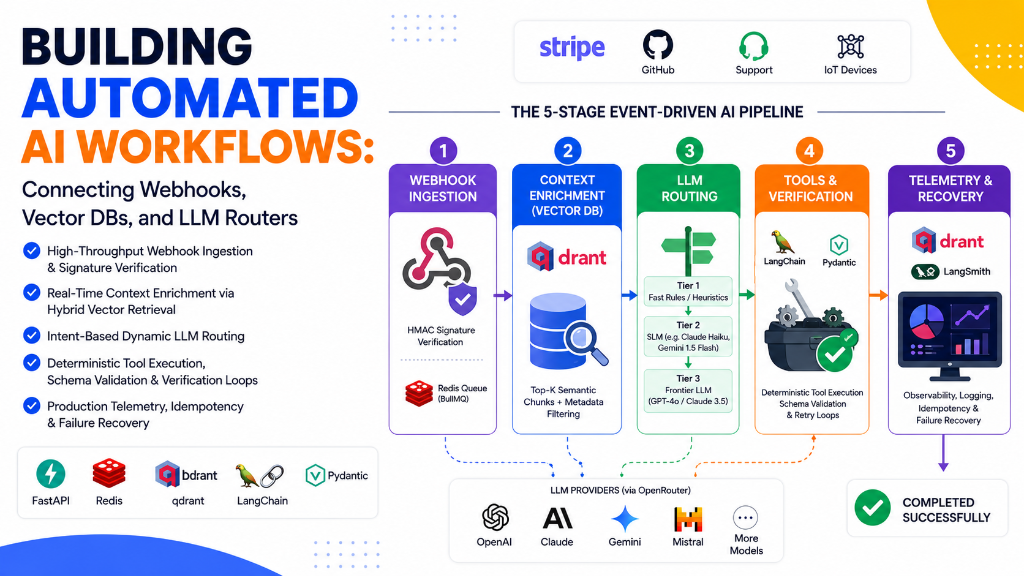
The modernization of software engineering in 2026 has crossed an inflection point: moving away from brittle, human-initiated chat prompts toward resilient, event-driven autonomous AI pipelines. Engineering teams building scalable web applications, SaaS platforms, and enterprise software can no longer treat Large Language Models (LLMs) as standalone black boxes invoked on synchronous HTTP routes.
When your application receives real-world traffic spikes such as thousands of concurrent Stripe invoice webhooks, GitHub repository pushes, customer support escalations, or IoT telemetry pulses synchronous model inference will bottleneck your infrastructure, exhaust timeout budgets, and rapidly inflate operational costs.
Production-grade artificial intelligence requires a decoupled, event-driven architecture. In this architectural deep dive, we design and implement an end-to-end event-driven AI workflow from the ground up, covering:
- High-Throughput Webhook Ingestion & Signature Verification with Redis-backed message queues.
- Real-Time Context Enrichment via Hybrid Vector Retrieval using metadata-filtered vector databases.
- Intent-Based Dynamic LLM Routing to optimize token unit economics and latency.
- Deterministic Tool Execution, Schema Validation & Verification Loops to eliminate hallucinations and runaway cycles.
- Production Telemetry, Idempotency & Failure Recovery.
1. Architectural Overview: The 5-Stage Event-Driven Pipeline
A robust AI automation pipeline must decouple incoming trigger events from heavy downstream reasoning engines. Rather than allowing third-party webhooks to block frontend API gateways, modern systems rely on a 5-stage asynchronous pipeline:
┌─────────────────────────┐
│ Incoming Webhook Event  │ (Stripe, GitHub, Zendesk, IoT)
└────────────┬────────────┘
             │
             ▼
┌─────────────────────────┐
│ Ingestion & Queue Gate  │ ──> Fast HTTP 202 Accepted (<25ms)
│ (BullMQ / Redis / SQS)  │
└────────────┬────────────┘
             │
             ▼
┌─────────────────────────┐
│ Context Enrichment RAG  │ <── Hybrid Search (Dense Vectors + BM25)
│ (Qdrant / PgVector)     │
└────────────┬────────────┘
             │
             ▼
┌─────────────────────────┐
│ Dynamic LLM Router      │ ──> Tier 1: Regex / Deterministic Rules
│ (Gateway & Fallbacks)   │ ──> Tier 2: Low-Latency SLM (e.g. Llama-3-8B)
└────────────┬────────────┘ ──> Tier 3: Frontier Reasoning (Claude 3.5 / GPT-4o)
             │
             ▼
┌─────────────────────────┐
│ Verification & Action   │ ──> Pydantic Schema Assertion & Retry
│ (Downstream Tool Call)  │ ──> Outbound Webhook / DB State Mutation
└─────────────────────────┘
By separating event consumption from context retrieval and model execution, each subsystem can scale independently, handle transient provider outages gracefully, and enforce strict execution SLAs.
2. Ingesting & Normalizing Webhooks at Scale
The entry point of your automation workflow is the webhook ingestion layer. Incoming webhooks are inherently unpredictable: a sudden product launch or batch job might trigger 5,000 webhook events in a 10-second window.
Executing expensive LLM API calls directly inside a webhook handler will inevitably trigger HTTP 504 gateway timeouts from upstream providers (e.g., Stripe retries transactions if an endpoint fails to respond within 2 seconds).
Step 1: Cryptographic Signature Verification & Queue Dispatch
Below is a production-grade TypeScript implementation using Express, crypto signature hashing, and BullMQ with Redis to acknowledge events in under 20ms:
import express, { Request, Response } from 'express';
import crypto from 'crypto';
import { Queue } from 'bullmq';

const app = express();

// Capture raw body buffer for accurate HMAC verification
app.use(express.json({
  verify: (req: Request, _res: Response, buf: Buffer) => {
    (req as any).rawBody = buf;
  }
}));

const workflowQueue = new Queue('ai-event-processing', {
  connection: {
    host: process.env.REDIS_HOST || '127.0.0.1',
    port: Number(process.env.REDIS_PORT) || 6379,
  }
});

// Middleware for HMAC-SHA256 signature verification
function verifyWebhookSignature(secret: string) {
  return (req: Request, res: Response, next: express.NextFunction) => {
    const signature = req.headers['x-hub-signature-256'] as string;
    if (!signature) {
      return res.status(401).json({ error: 'Missing webhook signature header' });
    }

    const hmac = crypto.createHmac('sha256', secret);
    const calculated = `sha256=${hmac.update((req as any).rawBody).digest('hex')}`;

    if (!crypto.timingSafeEqual(Buffer.from(signature), Buffer.from(calculated))) {
      return res.status(403).json({ error: 'Invalid webhook cryptographic signature' });
    }

    next();
  };
}

app.post(
  '/api/v1/webhooks/incoming',
  verifyWebhookSignature(process.env.WEBHOOK_SIGNING_SECRET || 'secret-key'),
  async (req: Request, res: Response) => {
    const event = req.body;

    // Enqueue job with idempotency key and exponential backoff
    await workflowQueue.add(
      'process-ai-workflow',
      {
        eventId: event.id || crypto.randomUUID(),
        tenantId: req.headers['x-tenant-id'] || 'default-tenant',
        eventType: event.type,
        payload: event.data,
        receivedAt: new Date().toISOString(),
      },
      {
        jobId: event.id, // Enforces strict idempotency; duplicates are ignored
        attempts: 4,
        backoff: {
          type: 'exponential',
          delay: 1500,
        },
        removeOnComplete: true,
      }
    );

    // Return instant 202 Accepted acknowledgment
    return res.status(202).json({
      status: 'queued',
      eventId: event.id,
      timestamp: Date.now(),
    });
  }
);

app.listen(3000, () => {
  console.log('🚀 High-velocity webhook ingestion listener online on port 3000');
});
3. Real-Time Semantic Context Enrichment with Vector Databases
Once an event is popped off the queue by a background worker, raw JSON data is rarely sufficient for an AI agent to execute complex decisions.
For instance, if a webhook alerts your system that a user submitted a dispute regarding an enterprise software contract, the agent requires context:
- What are the terms of the customer's Service Level Agreement (SLA)?
- What historical resolution precedents exist for similar accounts?
- What are the tenant's exact configuration parameters?
Modern AI workflow automation tools incorporate hybrid vector retrieval pipelines that query dense neural embeddings alongside sparse BM25 lexical keyword indexes to achieve sub-50ms context recall with zero cross-tenant data leakage.
Multi-Tenant Hybrid Retrieval in Python (Qdrant & FastEmbed)
import os
from qdrant_client import QdrantClient
from qdrant_client.models import (
    Filter, FieldCondition, MatchValue,
    SearchRequest, Prefetch
)

# Connect to Qdrant Vector Cluster
client = QdrantClient(
    url=os.getenv("QDRANT_URL", "http://localhost:6333"),
    api_key=os.getenv("QDRANT_API_KEY")
)

def retrieve_tenant_context(
    query_text: str,
    query_embedding: list[float],
    tenant_id: str,
    top_k: int = 4
) -> list[str]:
    """
    Executes a multi-tenant partitioned hybrid retrieval.
    Guarantees strict data isolation between enterprise organizations.
    """
    tenant_filter = Filter(
        must=[
            FieldCondition(
                key="tenant_id",
                match=MatchValue(value=tenant_id)
            ),
            FieldCondition(
                key="is_active",
                match=MatchValue(value=True)
            )
        ]
    )

    # Hybrid Search: Dense semantic proximity + Sparse payload matching
    search_results = client.search(
        collection_name="enterprise_knowledge_base",
        query_vector=query_embedding,
        query_filter=tenant_filter,
        limit=top_k,
        score_threshold=0.75, # Filter out low-confidence hallucinations
        with_payload=True
    )

    retrieved_chunks = [
        f"[Source: {hit.payload.get('document_title', 'Unknown')}]\n{hit.payload.get('content')}"
        for hit in search_results
    ]

    return retrieved_chunks
4. Intelligent LLM Routing & Cost Optimization
A common anti-pattern in early AI architectures is routing every single automation query to expensive frontier models like GPT-4o or Claude 3.5 Sonnet.
In high-volume automation pipelines processing 100,000 events daily, sending basic classification or parsing tasks to frontier models will rapidly inflate monthly API bills by tens of thousands of dollars while introducing 1,500ms+ latency penalties.
The 3-Tier Routing Hierarchy
A cost-efficient LLM router classifies incoming tasks dynamically across three performance tiers:
| Routing Tier | Ideal Tasks | Typical Latency | Cost per 1M Tokens |
|---|---|---|---|
| Tier 1: Deterministic Rules & AST Matchers | Regex classification, status code parsing, exact keyword matching | <5ms | $0.00 |
| Tier 2: Fast Small Language Models (SLMs) | Entity extraction, payload summarization, intent categorization | 150–350ms | $0.15–$0.60 |
| Tier 3: Frontier Reasoning Models | Multi-step logic, code generation, policy exception handling | 900–2,500ms | $5.00–$15.00 |
Production Python LLM Router Implementation
import os
import json
from typing import Dict, Any
from openai import OpenAI
from pydantic import BaseModel, Field

openai_client = OpenAI(api_key=os.getenv("OPENAI_API_KEY"))

class RoutingDecision(BaseModel):
    intent: str = Field(description="Categorized intent of the event")
    complexity_score: int = Field(description="1 (trivial) to 5 (complex reasoning)")
    target_model: str = Field(description="Selected LLM engine")

def classify_and_route_event(event_summary: str) -> str:
    """
    Evaluates event payload complexity and selects the optimal model tier.
    """
    # Fast heuristic checks for deterministic workloads
    if len(event_summary) < 80 and any(k in event_summary.lower() for k in ["ping", "health", "ack"]):
        return "deterministic_bypass"

    # Lightweight classification prompt using GPT-4o-mini
    classification_prompt = f"""
    Analyze the following event and classify its complexity:
    Event: {event_summary}

    Return JSON:
    - intent: (e.g. classification, data_extraction, complex_reasoning, policy_decision)
    - complexity_score: 1 to 5
    """

    response = openai_client.chat.completions.create(
        model="gpt-4o-mini",
        messages=[{"role": "user", "content": classification_prompt}],
        response_format={"type": "json_object"},
        temperature=0.0
    )

    decision = json.loads(response.choices[0].message.content)
    complexity = decision.get("complexity_score", 3)

    # Route based on complexity threshold
    if complexity <= 2:
        return "gpt-4o-mini" # Fast SLM path
    else:
        return "gpt-4o"      # Deep reasoning path
5. Structured Tool Calling & Safe Execution Loops
The ultimate business value of an AI workflow is its ability to trigger downstream actions such as refunding a transaction, provisioning a cloud container, generating an invoice, or updating a database record.
However, letting an AI model invoke downstream APIs with unvalidated string inputs is an invitation to critical production failures.
Enforcing Strict Output Schemas with Pydantic & Instructor
To prevent schema drifts and invalid parameters, downstream actions must be constrained by strict type validation and retry assertions:
from pydantic import BaseModel, Field, field_validator
import instructor
from openai import OpenAI

# Patch standard OpenAI client with Instructor for Pydantic guarantees
client = instructor.from_openai(OpenAI())

class DatabaseUpdateAction(BaseModel):
    account_id: str = Field(description="Target account UUID")
    action_type: str = Field(description="Action: suspend, upgrade, credit")
    credit_amount_cents: int = Field(default=0, description="Amount in cents to credit")
    justification: str = Field(min_length=15, description="Auditable reasoning for action")

    @field_validator("action_type")
    def validate_action(cls, v):
        allowed = ["suspend", "upgrade", "credit", "notify"]
        if v not in allowed:
            raise ValueError(f"Action '{v}' is not in authorized list: {allowed}")
        return v

    @field_validator("credit_amount_cents")
    def cap_maximum_credit(cls, v):
        MAX_AUTOMATED_CREDIT = 50000 # $500.00 max automated limit
        if v > MAX_AUTOMATED_CREDIT:
            raise ValueError(f"Credit amount {v} exceeds automated ceiling of {MAX_AUTOMATED_CREDIT}")
        return v

def execute_safe_action(enriched_context: str, user_request: str) -> DatabaseUpdateAction:
    """
    Executes structured reasoning with automated schema retry validation.
    """
    structured_action: DatabaseUpdateAction = client.chat.completions.create(
        model="gpt-4o",
        response_model=DatabaseUpdateAction,
        max_retries=3, # Automatically re-prompts model if validation fails
        messages=[
            {
                "role": "system",
                "content": "You are an automated operations engine. Extract verified action parameters."
            },
            {
                "role": "user",
                "content": f"Context:\n{enriched_context}\n\nTask:\n{user_request}"
            }
        ]
    )
    return structured_action
6. Key Production Best Practices & Architectural Checklist
Before deploying your event-driven AI workflow to live production environments, review this operational checklist:
- Enforce Idempotency at Every Layer: Always generate deterministic job IDs derived from upstream event IDs (
x-event-idor transaction hash). If a webhook sends duplicate delivery payloads, the queue must drop duplicates instantly. - Implement Semantic Caching: Integrate an intelligent proxy gateway (such as Portkey or Redis Semantic Cache) to cache identical intermediate reasoning outputs, cutting redundant API costs by up to 35%.
- Decouple Secrets from Prompt Context: Never allow raw API tokens or customer PII to enter vector indexes. Use regex scrubbers and entity redaction prior to embedding generation.
- Set Hard Circuit Breakers: Multi-agent self-correction loops must have hard iteration bounds (
max_iterations = 4) and per-tenant budget ceilings to prevent runaway recursive token spend during model loops. - Continuous Telemetry & Tracing: Pipe all model spans, prompt latencies, and token costs to an open-source observability platform (such as Langfuse) to maintain real-time visibility into production performance.
Conclusion
Building automated AI workflows in 2026 is an exercise in distributed systems engineering. By treating LLMs not as conversational endpoints, but as intelligent routing and reasoning components embedded within asynchronous message queues and vector retrieval pipelines, engineering teams can build software that scales reliably to millions of events with rock-solid predictability.