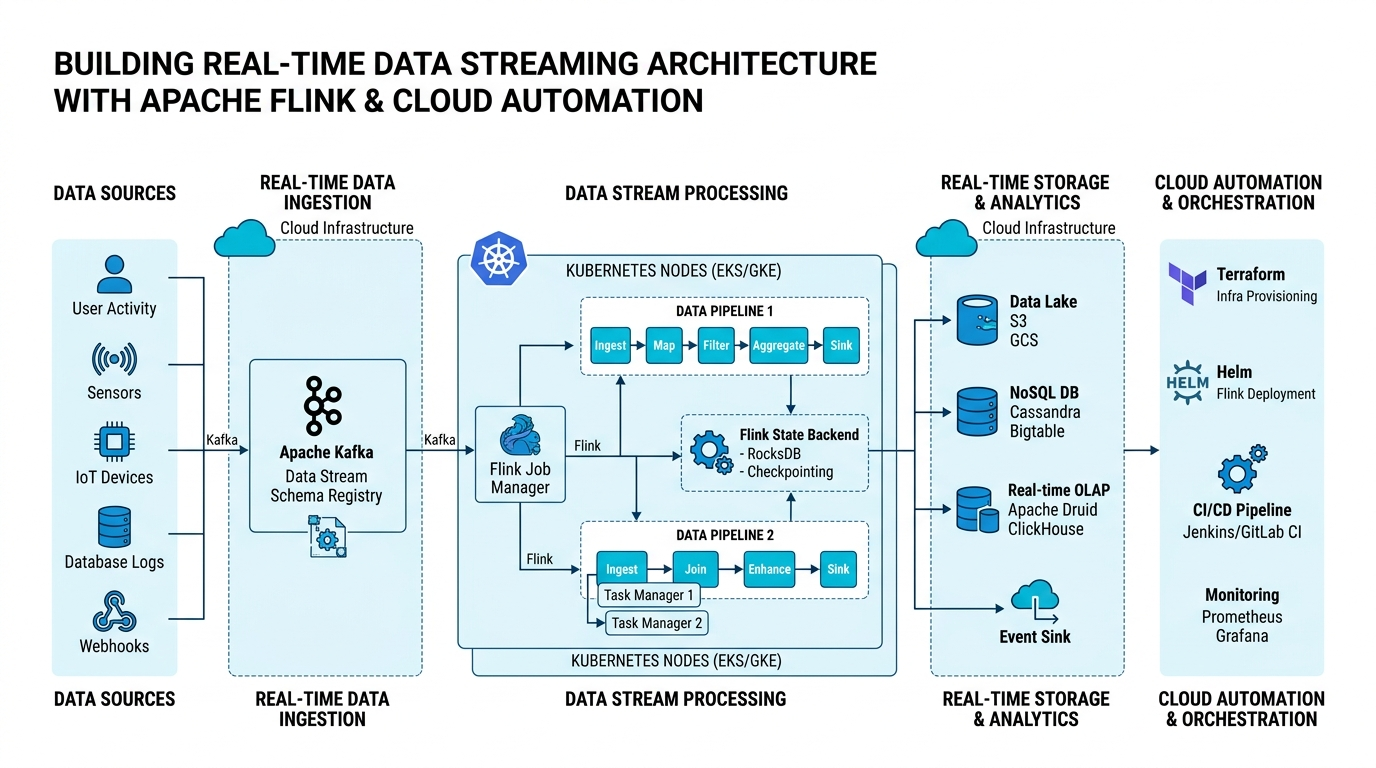
Building Real-Time Data Streaming Architecture with Flink & Cloud Automation
Modern SaaS platforms generate massive volumes of events every second. User interactions, payment transactions, IoT devices, monitoring systems, and application logs all produce continuous streams of data that must be processed in real time. Traditional batch processing is often too slow for modern business requirements, making stream processing an essential part of enterprise software architecture.
Apache Flink has become one of the leading frameworks for building reliable, scalable, and fault-tolerant streaming applications. Combined with Kubernetes and cloud-native deployment practices, it enables engineering teams to process large-scale event streams with low latency while maintaining high availability.
Why Real-Time Streaming Matters
Many modern applications depend on instant data processing. Fraud detection systems must identify suspicious transactions immediately. Billing platforms need accurate event processing for usage-based pricing. Monitoring solutions require real-time alerts before incidents affect customers.
A well-designed streaming architecture allows organizations to:
- Reduce processing latency.
- Scale horizontally as traffic grows.
- Improve operational visibility.
- Support event-driven microservices.
- Deliver better customer experiences.
Companies investing in modern cloud-native platforms often combine event streaming with scalable engineering practices similar to those used by the [CloudLink Engineering Team] https://cloudlink.us/ when designing enterprise cloud solutions.
Core Components of a Flink Architecture
A typical production-ready streaming platform includes several key components:
Event Source
Events usually originate from Kafka, cloud messaging services, REST APIs, databases, or IoT devices. These sources continuously generate records that are consumed by Flink jobs.
Stream Processing
Apache Flink performs operations such as:
- Filtering invalid events
- Data transformation
- Window aggregation
- Stateful processing
- Event enrichment
- Real-time analytics
Its checkpointing mechanism ensures fault tolerance even when infrastructure failures occur.
Storage Layer
Processed data can be written to data warehouses, object storage, Elasticsearch, relational databases, or analytics platforms depending on business needs.
Monitoring
Observability is critical. Metrics, logs, and traces help engineers detect bottlenecks before they impact production workloads.
Deploying Flink with Kubernetes
Running Flink on Kubernetes provides significant operational advantages.
Container orchestration enables automatic scaling, rolling updates, resource isolation, and simplified deployment management. Infrastructure teams can define CPU, memory, storage, and networking policies while Kubernetes handles scheduling and recovery.
Best practices include:
- Deploy multiple JobManagers for resilience.
- Configure automatic checkpointing.
- Use persistent storage for state backends.
- Define CPU and memory requests appropriately.
- Monitor cluster health continuously.
Organizations building enterprise cloud environments frequently integrate these deployment patterns into their [Cloud Engineering services] https://cloudlink.us/#services to improve reliability and simplify operations.
Performance Optimization
Several techniques help maximize streaming performance:
Parallel Processing
Increase task parallelism to distribute workloads across multiple workers.
Efficient Serialization
Use compact serialization formats such as Avro or Protobuf to reduce network overhead.
State Management
Choose the appropriate state backend and configure incremental checkpoints for faster recovery.
Resource Allocation
Avoid under-provisioning compute resources while preventing unnecessary infrastructure costs.
Common Challenges
Despite its strengths, real-time streaming introduces architectural challenges.
Large event spikes may overwhelm poorly configured clusters. Improper checkpoint intervals can increase recovery times. Complex event pipelines require careful testing to prevent data loss or duplication.
Engineering teams should regularly validate deployments under realistic workloads before promoting changes to production.
Practical Example
Imagine a SaaS analytics platform processing millions of customer events every day.
Each event enters Kafka before being consumed by Apache Flink. The processing pipeline validates incoming data, enriches customer information, calculates business metrics, and routes the results to multiple downstream systems.
Operations teams monitor latency, throughput, and processing failures using centralized dashboards. Kubernetes automatically replaces failed containers and scales additional workers when traffic increases.
This architecture provides near real-time insights while maintaining high availability and operational resilience.
Best Practices
When designing streaming systems, consider the following recommendations:
- Design pipelines around events rather than batch jobs.
- Automate testing before every deployment.
- Monitor latency and checkpoint performance.
- Separate development, staging, and production environments.
- Document recovery procedures.
- Continuously optimize infrastructure costs.
Businesses serving multiple industries, including those highlighted on the [CloudLink Markets page] https://cloudlink.us/markets, often rely on these engineering principles to deliver scalable cloud applications for enterprise clients.
Conclusion
Apache Flink and Kubernetes provide a powerful foundation for modern event-driven applications. Together they enable organizations to process massive streams of data with low latency, strong fault tolerance, and efficient scalability.
Whether you're building SaaS platforms, financial systems, monitoring solutions, or analytics applications, investing in a well-designed streaming architecture improves reliability, operational efficiency, and long-term scalability.
As demand for real-time applications continues to grow, adopting cloud-native streaming technologies will remain a key advantage for engineering teams building the next generation of enterprise software.