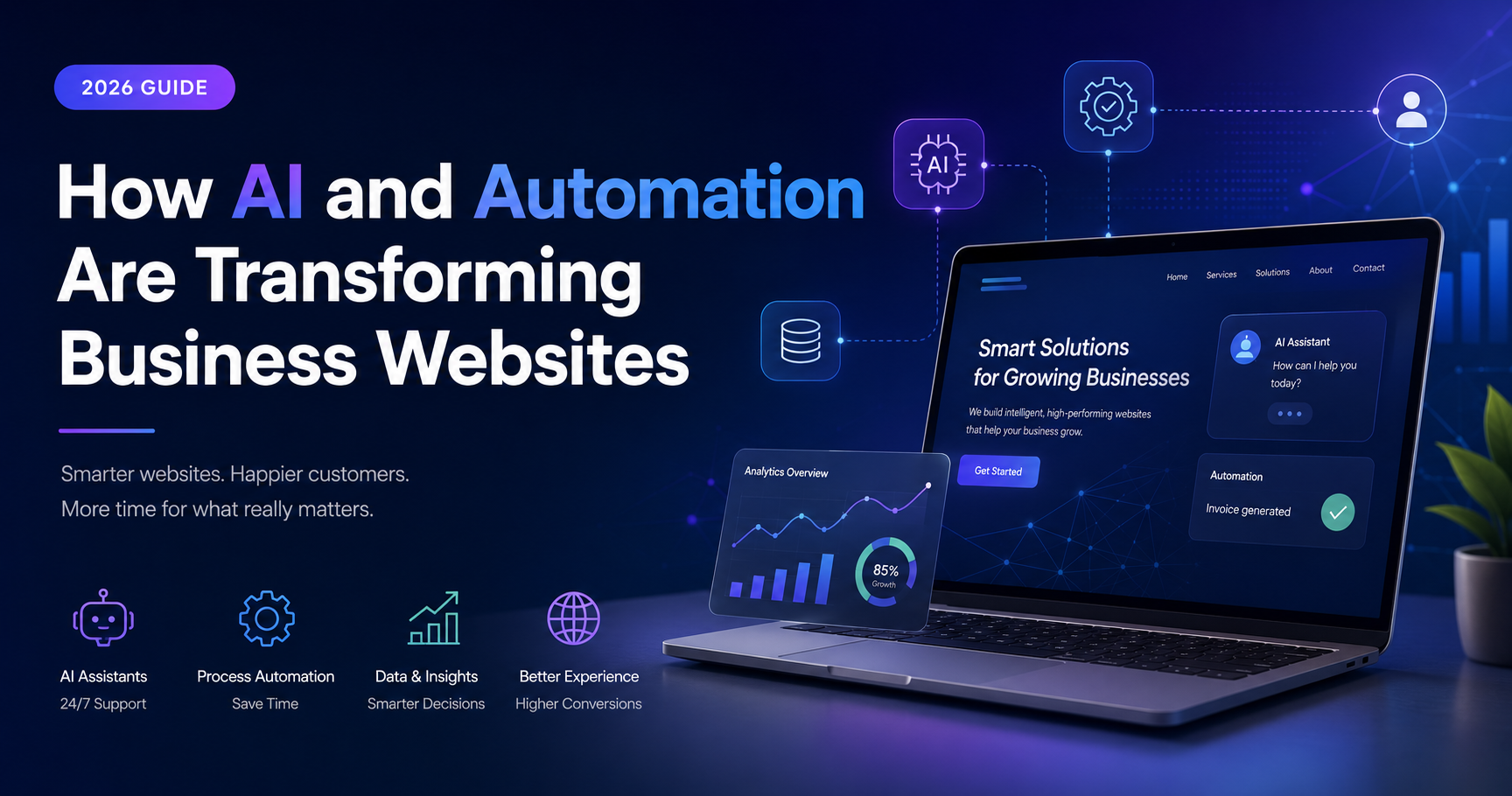
How AI and Automation Are Transforming Business Websites in 2026
Business websites are changing rapidly. A few years ago, having a fast, responsive, and visually appealing website was enough for many companies. In 2026, however, businesses increasingly expect their websites to do much more than simply display information.
Modern websites are becoming intelligent digital systems that can answer customer questions, automate repetitive tasks, analyze user behavior, qualify leads, personalize experiences, and connect different parts of a business.
Artificial intelligence and automation are driving much of this transformation.
The important question for businesses is no longer simply, "Should we use AI?" Instead, companies need to determine where AI and automation can create measurable value without making their websites unnecessarily complicated.
From Static Websites to Intelligent Business Systems
Traditional business websites were primarily designed around pages: Home, About, Services, Blog, and Contact.
That structure is still useful, but the role of the website has expanded.
A modern website can function as a central digital hub connecting customers with sales, support, marketing, analytics, e-commerce, and internal business processes.
For example, when a potential customer submits an inquiry, automation can immediately organize the information, send a confirmation, notify the appropriate team member, and add the lead to a CRM system.
AI can take this further by analyzing the inquiry, identifying its intent, and helping determine the most appropriate next action.
This changes the website from a passive marketing asset into an active part of business operations.
1. AI Assistants Are Changing Customer Support
One of the most visible applications of AI on business websites is the AI assistant.
Traditional chatbots typically depend on predefined questions and answers. Modern AI assistants can understand more flexible language and provide responses based on a company's services, documentation, policies, and knowledge base.
A well-designed AI assistant can help visitors:
- Find relevant services
- Understand products
- Navigate large websites
- Answer common questions
- Find documentation
- Submit detailed inquiries
- Receive basic support outside business hours
However, businesses should avoid treating AI assistants as replacements for every human interaction.
Complex complaints, negotiations, sensitive issues, and high-value sales conversations often require human judgment.
The strongest implementation is usually a hybrid model: AI handles repetitive interactions while humans remain available when their expertise is needed.
2. Automation Can Improve Lead Management
Many companies spend significant time manually processing website inquiries.
A visitor completes a form, someone reads the message, categorizes it, forwards it, enters information into another system, and eventually responds.
Much of this workflow can be automated.
For example:
- A visitor submits a project inquiry.
- The website validates and organizes the information.
- The lead is automatically added to the company's CRM.
- The appropriate team member receives a notification.
- The customer receives an immediate confirmation.
- The inquiry is categorized according to service type or priority.
- Follow-up actions can be scheduled automatically.
Automation does not eliminate the sales process. It removes unnecessary administrative steps so the sales team can spend more time communicating with qualified prospects.
3. Personalization Is Becoming More Practical
Personalization used to be associated primarily with large e-commerce platforms.
AI is making it increasingly practical for smaller businesses as well.
A website can adapt certain experiences based on contextual signals such as previous interactions, selected services, referral sources, or browsing behavior.
For example, a visitor exploring mobile application development may see relevant case studies or resources rather than generic content.
An e-commerce customer may receive more relevant product recommendations.
A returning visitor may be directed toward information related to content they previously viewed.
The goal should not be personalization for its own sake. Every personalized element should make the website easier or more useful for the visitor.
4. AI Can Support Content and SEO Workflows
AI has also become an important tool in content production and search engine optimization.
It can assist teams with:
- Topic research
- Content outlines
- Keyword organization
- Metadata drafts
- FAQ generation
- Content classification
- Internal linking opportunities
- Updating outdated information
- Analyzing large sets of search data
However, publishing large quantities of automatically generated content without editorial review is not a sustainable SEO strategy.
Search-focused content still needs accuracy, expertise, originality, useful information, and a clear understanding of search intent.
AI should accelerate research and production rather than replace editorial judgment.
This approach is especially important when building a broader digital strategy. Agencies such as Nexio Market increasingly combine web development, SEO, AI solutions, and automation because these disciplines are becoming interconnected rather than separate parts of a digital project.
5. Business Websites Are Becoming Connected Platforms
Another major transformation is happening behind the interface.
Modern websites increasingly communicate with other business systems through APIs and automation platforms.
A website may connect with:
- CRM software
- Email marketing platforms
- Analytics systems
- Payment gateways
- Inventory systems
- Appointment scheduling tools
- Customer support platforms
- Accounting software
- Internal databases
- AI services
These integrations reduce duplicated work and help information move between systems more efficiently.
Consider an online service business.
When a customer places an order, the website can process the payment, create an internal record, notify the relevant department, update analytics, send confirmation messages, and initiate the next operational step.
Instead of employees manually transferring information between several platforms, the systems communicate automatically.
6. AI Analytics Can Help Businesses Understand Visitors
Traditional website analytics tell businesses what happened.
They show metrics such as traffic, sessions, conversions, traffic sources, and popular pages.
AI-assisted analytics can help businesses examine larger patterns within this information.
Companies may use these tools to identify:
- Common customer journeys
- Pages where visitors frequently leave
- High-performing traffic sources
- Changes in conversion behavior
- Frequently searched topics
- Common customer questions
- Potential usability problems
These insights can help teams make more informed decisions about website design, content, marketing, and customer experience.
AI analysis should still be combined with reliable data and human interpretation. A recommendation generated from incomplete or misleading data can produce the wrong conclusion.
7. Automation Should Improve User Experience, Not Complicate It
One of the biggest mistakes businesses can make is adding technology simply because it is available.
A website filled with unnecessary pop-ups, automated messages, aggressive chat windows, and complicated personalization can become more frustrating rather than more intelligent.
Good automation should often be almost invisible.
Users should notice that:
- Forms are easier to complete.
- Responses arrive faster.
- Relevant information is easier to find.
- Navigation feels intuitive.
- Support is more accessible.
- Processes require fewer unnecessary steps.
The technology should support the experience rather than dominate it.
8. Performance, Security, and Privacy Still Matter
AI features do not remove traditional web-development requirements.
In fact, increasingly connected websites make technical quality even more important.
Businesses still need to prioritize:
- Website performance
- Mobile responsiveness
- Secure connections
- Software updates
- Access control
- Backups
- Data protection
- Reliable hosting
- Accessibility
- Technical SEO
Every additional integration can introduce new dependencies and potential security risks.
Businesses should therefore evaluate what data an AI or automation system receives, where that information is processed, and whether the integration is actually necessary.
This is particularly important when customer information, financial information, or confidential business data is involved.
9. Start With Business Problems, Not AI Features
The best AI strategy usually begins without discussing AI.
Businesses should first identify repetitive tasks, customer frustrations, operational bottlenecks, and opportunities for improvement.
Useful questions include:
- Which customer questions are repeatedly answered manually?
- Where does the sales process slow down?
- Which website tasks require unnecessary manual work?
- Where are potential leads being lost?
- Which systems require employees to copy information manually?
- What information do customers struggle to find?
- Which processes could benefit from faster response times?
Once these problems are clearly identified, businesses can determine whether AI, conventional automation, better UX design, or a combination of technologies provides the best solution.
Sometimes AI is appropriate.
Sometimes a simple automated workflow is better.
And sometimes redesigning a confusing page solves the problem without requiring either.
What Will Business Websites Look Like Next?
The distinction between a "website" and a "business platform" will continue to become less clear.
Websites are increasingly becoming interfaces through which customers communicate with intelligent systems, access services, make purchases, manage accounts, receive personalized information, and interact with automated business processes.
AI will play an important role in this evolution, but successful websites will not be defined by how many AI features they contain.
They will be defined by how effectively technology solves real problems.
Conclusion
AI and automation are transforming business websites from static information channels into connected digital systems.
AI assistants can improve accessibility to information. Automation can reduce repetitive administrative work. Integrations can connect websites with critical business platforms. Intelligent analytics can provide deeper insights, while personalization can make digital experiences more relevant.
But successful implementation requires balance.
Businesses should prioritize usability, security, performance, privacy, and measurable business outcomes before adding new technology.
The most effective website in 2026 is not necessarily the website with the most AI.
It is the website that uses the right technology, in the right places, to create a better experience for customers and a more efficient system for the business.