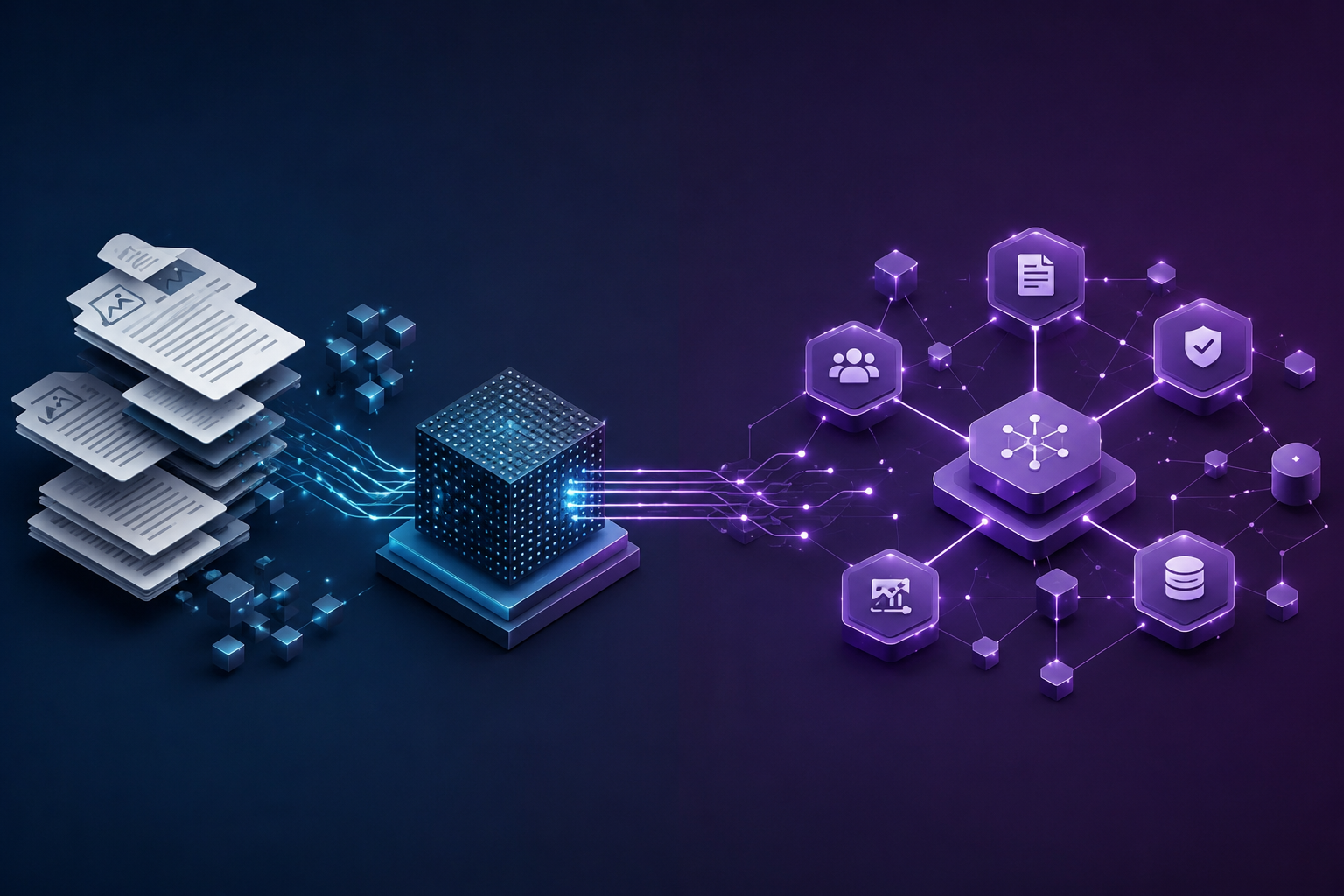
A machine learning model is not production-ready because it performs well on a clean test dataset. It is production-ready when it can handle unreliable real-world inputs, fit into a useful workflow, protect sensitive data, stay within acceptable cost and latency limits, and fail safely when it is uncertain.
That distinction matters. A model demo can be built in days. A dependable production-ready ML model takes deliberate engineering around the model itself.
At Bridge Homies, we build AI-enabled systems for practical business workflows, including document processing, operational automation, AI search, conversation summarisation, and context extraction. Our strongest live products today are SaaS platforms, while projects such as WhisperCRM demonstrate where production AI creates value: bringing Gmail and WhatsApp conversations into one timeline, summarising context, and helping internal sales or support teams work faster.
What production-ready actually means
A production-ready ML model is part of a complete system. It has defined inputs and outputs, clear success criteria, monitoring, error handling, privacy controls, versioning, and a human fallback for uncertain or high-risk cases.
A notebook hides almost every hard problem. A model can look impressive with clean sample data, then struggle when real users upload blurry files, use inconsistent labels, write in mixed Urdu and English, or submit incomplete information. The model may still respond, but the product breaks because inputs are malformed, API calls time out, costs spike, or there is no fallback when confidence is low.
Start with the business decision, not the model
Before choosing a model, define the exact job it must perform and the consequence of being wrong. “Use AI to process invoices” is too vague. A production use case is more specific: extract supplier name, invoice number, date, tax amount, and line items from uploaded invoices; automatically accept high-confidence fields and send uncertain cases for review.
This framing makes the workflow, evaluation criteria, and fallback path visible before development starts. The goal is not to make a model answer every request. The goal is to make the system useful, predictable, and trustworthy.
- What exact user problem are we solving?
- What action will the output trigger?
- Is a wrong answer inconvenient, expensive, illegal, or dangerous?
- Can a human review uncertain output?
- Does ML genuinely perform better here than rules, search, or a manual workflow?
Decide whether ML is the right solution
Not every intelligent-looking feature needs machine learning. In many business systems, deterministic rules are more accurate, cheaper, easier to explain, and easier to maintain. Tax calculations, invoice validation, permissions, compliance rules, and workflow states should primarily use rules because the result must be traceable and consistent.
RAG is more appropriate when users need answers grounded in documentation that changes over time, such as policies, product manuals, legal material, or internal knowledge bases. If you are deciding between retrieval and a trained model, see our guide on the difference between fine-tuning and RAG. Human review is better when a wrong answer carries legal, financial, or reputational risk.
ML and LLMs are most useful where information is messy, unstructured, or difficult to process with conventional logic. That includes summarising conversations, extracting information from inconsistent documents, classifying and routing incoming requests, ranking records, detecting anomalies, and building natural-language interfaces for structured systems.
Treat data quality as the main project
Most production ML problems are data problems disguised as model problems. Data may come from customer documents, inbox conversations, application records, exports, spreadsheets, and domain-specific public material. The difficult part is rarely just how much data exists. It is whether that data represents real conditions.
The same field may appear under different names, dates may use different formats, PDFs may be scanned poorly, and users may enter information differently. A model trained only on neat examples will fail quietly in these situations. Build an evaluation dataset that includes ordinary examples alongside incomplete, multilingual, duplicate, ambiguous, and low-quality inputs.
Measure business value, not raw accuracy
Raw accuracy is not the main business metric. A system can achieve strong benchmark results and still be unusable if it confidently makes the wrong recommendation, takes too long, costs too much per request, or forces users to repeatedly correct its output.
- Correctness on the fields that actually matter
- Percentage of cases requiring human review
- False-positive rate
- Response time and queue delay
- Cost per successful task
- User correction rate and trust
For document extraction or classification, field-level correctness often matters more than a single overall score. If the invoice number or tax amount is wrong, an otherwise accurate document result may still be unusable.
Build the workflow around uncertainty
A production model should not be forced to act certain when it is not. Design three paths: automatic acceptance for high-confidence, low-risk output; human review for incomplete or ambiguous output; and safe failure when the input is invalid or an upstream service is unavailable.
For example, an invoice extraction workflow can automatically fill clear fields, highlight uncertain values, retain the original document beside the extracted data, and let a user approve or correct it. Human corrections are not merely a safety mechanism. They are the most valuable feedback dataset for improving prompts, retrieval, rules, evaluation cases, or a future custom model.
Use an architecture designed for real workloads
Small teams do not need an elaborate MLOps platform on day one. They do need separation between user-facing requests and long-running AI work. A practical architecture uses React, Next.js, or Vite on the frontend; FastAPI or Node.js for backend APIs; PostgreSQL for product data and audit logs; S3-compatible storage for uploaded documents; and Redis with Celery or RQ for background jobs.
Managed LLM APIs are usually the right choice for an initial version. They reduce time to market and let teams validate value before committing to model infrastructure. For help evaluating platforms for deploying machine learning models in production, compare privacy controls, pricing, model availability, observability, regional requirements, and the effort required to operate each option.
The key design choice is to keep AI work asynchronous wherever possible. A user should not wait inside a normal web request while a large document is processed or a long conversation is summarised. Create a job, place it in a queue, track its status, process it through workers, and notify the user when it is complete.
Design for failure before launch
Production AI systems fail in ordinary ways. Inputs are missing. A provider rate-limits requests. A third-party API changes a schema. A retry loop creates duplicate jobs. A prompt update quietly reduces quality. Plan for these situations before the product reaches users.
Every AI workflow should include input validation, timeout limits, retry policies with backoff, idempotent jobs, structured error states, and a clear path for human review. Store enough context to investigate failures: input metadata, prompt or model version, response status, processing time, cost, and the action a user took after seeing the output.
Protect privacy and version the full AI system
For financial, legal, compliance, and customer-data workflows, privacy is not an afterthought. Define access controls, data-retention policies, redaction requirements, audit logs, and which data can be sent to external providers. Sensitive invoice and customer data should not be sent to a third party merely because an AI API is convenient.
Version more than the model. Prompt changes, retrieval settings, OCR configuration, business rules, parsers, and third-party model updates can all change the final output. Store these versions so your team can investigate regressions, compare releases, and roll back safely through feature flags.
Validate at five levels before release
- Offline testing on representative historical examples, not only ideal samples
- Edge-case testing for incomplete, ambiguous, multilingual, duplicate, and low-quality inputs
- Security and privacy checks for access controls, retention, redaction, and audit logging
- Performance testing for latency, concurrency, queue behaviour, and cost per request
- Limited real-user release with approval, correction, rejection, and feedback controls
The last stage is where product reality becomes clear. Users reveal whether output is genuinely helpful, whether the review experience is sensible, and whether the model saves time instead of creating correction work.
How long and how much does it take?
A focused first production version usually takes six to twelve weeks, not a vague promise to build an “AI platform.” Discovery and success criteria typically take one to two weeks. Data collection, cleaning, and validation often require two to four weeks. Model, prompt, RAG, or pipeline development can take another two to four weeks, followed by integration, monitoring, security checks, testing, and controlled launch.
Cost depends heavily on data quality, integration complexity, and whether a custom model is truly required. A focused LLM, RAG, or document-automation MVP can often begin in the low thousands of dollars. A custom model with data collection, annotation, evaluation infrastructure, deployment, and ongoing MLOps can move into tens of thousands. Ongoing maintenance must also be budgeted for: monitoring, evaluations, provider costs, data review, and model or prompt changes are not one-time work.
Final takeaway
Building a production-ready ML model is less about chasing the newest model and more about building a system that behaves responsibly under real conditions. The strongest AI products do not pretend to be correct all the time. They know when to use rules, when to retrieve grounded information, when to ask a human, and when to fail safely.
Start with one focused workflow, representative data, meaningful evaluation, and a clear review path. That is how you move from a promising notebook demo to a product that people can actually trust.