
According to Gartner's search market research, traditional search engine volume is dropping by 25% as generative AI chatbots and answer engines reshape how users discover information online. This structural shift has created a dual challenge for software and marketing teams: content must not only rank on traditional Search Engine Optimization (SEO) result pages, but it must also be structured for Answer Engine Optimization (AEO) to be cited by platforms like ChatGPT, Perplexity, and Google AI Overviews.
Most organizations attempt to solve this challenge by passing massive prompts into a single Large Language Model (LLM) call. The result is almost always generic, shallow content that suffers from hallucinations, thin content flags, and poor search performance.
Building a content engine that consistently ranks and secures answer-engine citations requires moving away from simple prompt tricks toward production-grade software engineering.
Why Single-Prompt Generators Fail Production Standards
When teams first explore automated publishing, they usually build a linear script: take a keyword, wrap it in a system prompt ("Write a 1,500-word SEO blog post"), and push the raw LLM string directly into a WordPress or headless CMS webhook.
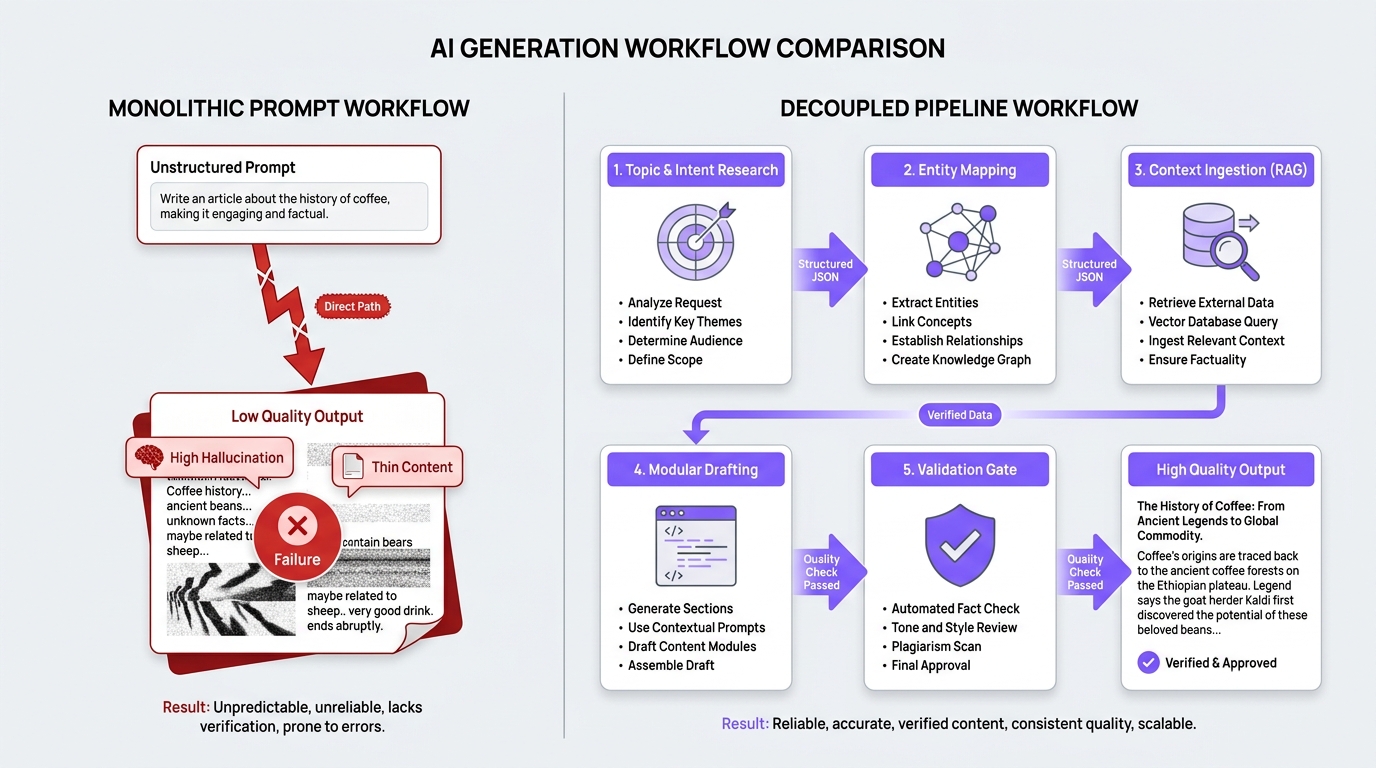
From a software architecture standpoint, this approach treats a highly complex multi-step workflow as a black box. Single-prompt generation fails in production for four fundamental reasons:
- Context Drift and Hallucination: LLMs lose instruction precision as context windows expand. A single prompt asking for outline creation, entity insertion, tone matching, and citation fetching causes model attention mechanisms to compromise on formatting and factual accuracy.
- Lack of Information Gain: AI models generate the statistical average of their training data. Without an external retrieval mechanism, the output simply rehashes existing top-ranking pages without adding fresh data or unique perspectives.
- Monolithic Failure Modes: If the LLM generates a bad intro, invents a fake statistic, or mangles markdown formatting, the entire execution fails or requires manual human re-writing.
- Poor Entity Structuring: Search engines do not rank words; they index entities and relationships. A single-prompt completion lacks the structural constraints required to build clear semantic relationships that generative answer engines can extract.
To solve these systemic flaws, production engineering teams decouple content generation into discrete, state-managed micro-tasks.
Decoupling the Pipeline into Modular Execution Stages
An autonomous content architecture should behave like a compiled build pipeline. Each stage takes structured JSON input, executes a specific deterministic or probabilistic transformation, validates its output against strict criteria, and passes the payload to the next node.
[ Keyword Input ] ➔ [ Entity & Intent Parser ] ➔ [ Context Retrieval (RAG) ]
│
[ CMS Webhook ] [ Schema & Quality Gate ] [ Draft Synthesizer ]
Stage 1: Intent Parsing and Entity Mapping
Before drafting a single sentence, the system must analyze search intent and map the underlying entity graph. Instead of relying solely on keyword volume, the pipeline queries search APIs to extract:
- Primary entities and secondary LSI (Latent Semantic Indexing) terms.
- User intent classifications (Informational, Commercial, Transactional).
- Direct question clusters extracted from "People Also Ask" and conversational engines.
Stage 2: Context Ingestion and Retrieval-Augmented Generation (RAG)
To guarantee high information gain, the pipeline must ingest real-world data before generation begins. Rather than relying on static model weights, real-time facts, internal documents, and authoritative external references are retrieved dynamically. Understanding when to use real-time retrieval versus model parameter tuning is crucial when learning how to integrate an LLM into existing software applications effectively.
When sourcing real-time factual data versus relying on fine-tuned domain models, architecture teams must weigh trade-offs around latency and data freshness—a distinction detailed in this analysis of the difference between fine-tuning and RAG.
Optimizing Content for Generative Answer Engines (AEO)
Answer engines extract concise, authoritative facts from structured documents. If your software pipeline outputs long-winded, fluff-filled introductory paragraphs, generative parsers will skip your page entirely.
To maximize visibility across AI search interfaces, the pipeline must enforce structural constraints during the drafting phase:
- Direct Answer Paragraphs (The 150-Word Rule): Every major section heading (
H2orH3) must immediately be followed by a direct, declarative answer within the first 2 to 3 sentences. - Predictable Heading Hierarchies: Use logical markdown nesting. Never skip heading levels, as LLM parsers use heading tags to build structural outlines of page nodes.
- Entity-Rich Sentence Construction: Replace vague pronouns ("it", "they", "this tool") with specific named entities (e.g., "PostgreSQL", "React 19", "OAuth 2.0 PKCE flow").
- Structured Schema Ingestion: The final stage of your pipeline should automatically output valid Schema.org JSON-LD markup (
TechArticle,FAQPage, orHowTo), embedding entity metadata directly into the rendered HTML head.
Integrating these structural rules directly into your publishing pipeline allows your team to maintain modern SEO and AEO content ops at scale without expanding editorial headcount.
Programmatic Quality Gates and Automated Validation
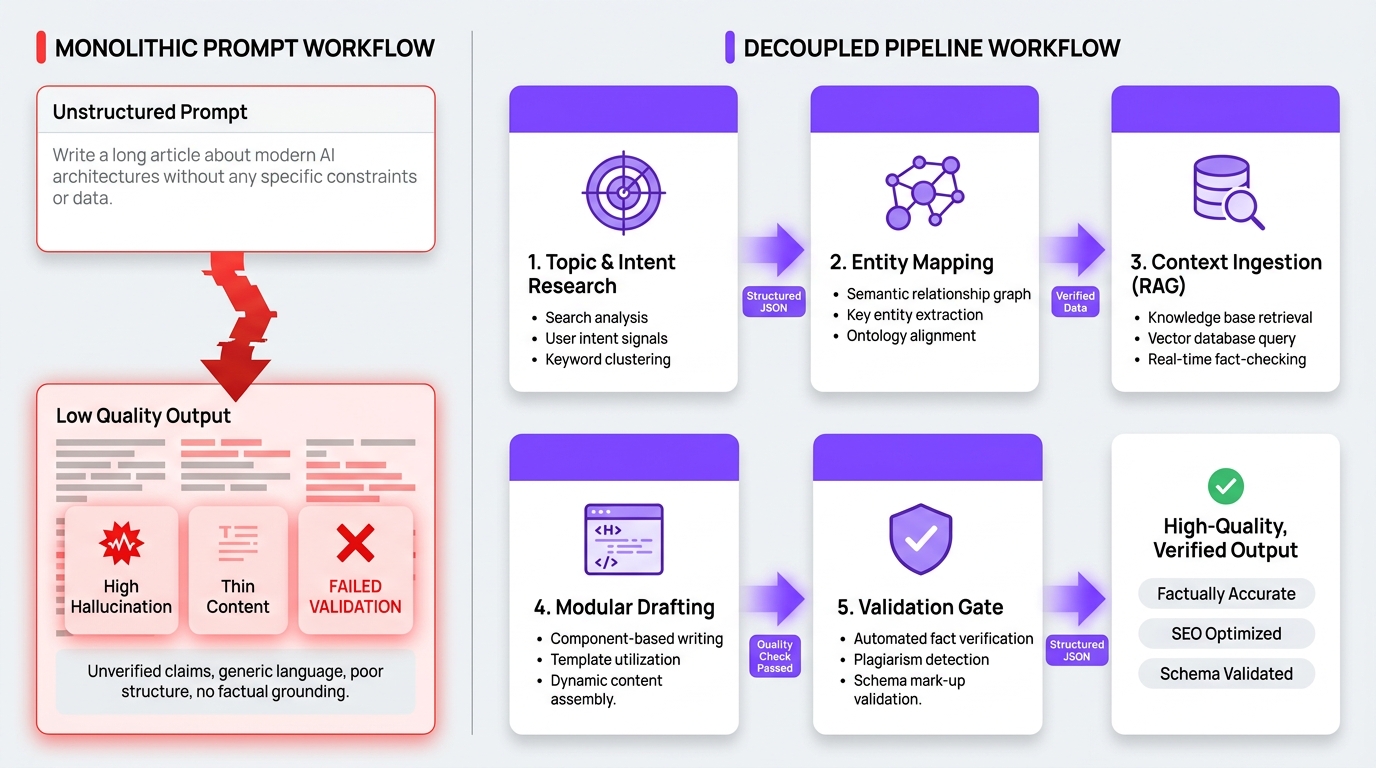
An autonomous pipeline is only as reliable as its validation layer. Before any generated draft touches a live CMS, it must pass through an automated evaluation suite.
Key validation gates include:
- Plagiarism & Copy Checking: Run outputs against specialized plagiarism detection APIs to ensure phrasing is completely original.
- Citation Verification: Validate that every external link embedded in the article resolves to a live, status-200 URL from a reputable domain.
- Grammar and Style Constraints: Programmatically strip out repetitive LLM stylistic markers (e.g., "In today's fast-paced digital landscape," "Delve," "Testament," "It's worth noting that").
- Information Gain Verification: Measure vector similarity against existing top-10 search results to verify the article introduces novel data or framing.
When engineering production content systems, teams must design programmatic quality gates to evaluate information gain, factual accuracy, and what Google actually ranks when evaluating automated blogs before publishing.
Building these verification layers requires treating content production as an engineering challenge rather than a copywriting task, leveraging dedicated engineering automation and AI services to build custom validation pipelines.
Asset Integration and Webhook-Driven Publishing
A fully autonomous pipeline extends beyond text generation. To deliver a complete editorial product, the system must handle media generation and internal linking:
- Visual Asset Generation: Use dedicated image generation pipelines to produce brand-consistent illustrations. Rather than generic stock photos, generate functional architecture diagrams, comparative tables, and minimalist 3D renders that explain complex technical concepts visually.
- Contextual Internal Linking: Maintain a live vector index of all previously published articles on your domain. During the drafting phase, perform semantic search queries against your site index to insert contextual internal links naturally inline.
- Asset Asset Management (DAM) Integration: Automatically upload generated visual assets to a centralized cloud storage or DAM platform, optimizing file sizes and injecting keyword-descriptive alt tags. Streamlining asset handling between creation tools and production environments is why seamless integration between DAM and everyday tools is critical for productivity.
- CMS Webhook Dispatch: Once all validation checks pass, compile the payload into standardized Markdown/JSON and dispatch it directly to your headless CMS via REST or GraphQL APIs.
Final Thoughts
The era of relying on simple AI writing prompts to drive organic traffic is over. As search engines evolve into direct answer engines, visibility requires technical rigor, structural precision, and guaranteed content quality.
By decoupling generation into discrete micro-tasks, enforcing programmatic quality gates, and embedding structured schema, engineering teams can build content pipelines that operate reliably, scale efficiently, and perform across both traditional and generative search engines.